

Walk into a leading bar or nightclub in 2026 and the lighting does more than illuminate the room — it is the show. LED pixel lighting has moved from a decorative extra to the centrepiece of venue design, and the projects getting the most attention share a few clear directions. Here are four trends shaping pixel lighting for bars, stages and night venues this year.
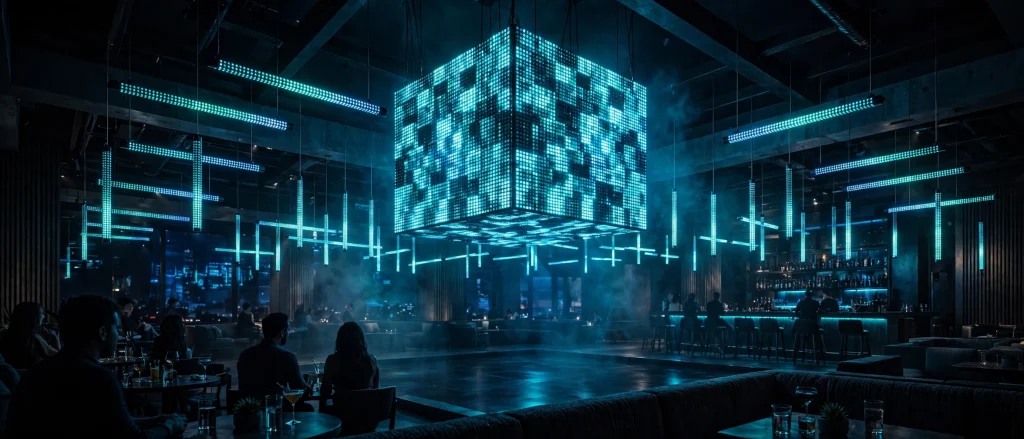
1. 3D Matrix and Volumetric Displays
Flat LED walls are giving way to three-dimensional structures. Pixel matrices are now built as cubes, spheres, tunnels and free-hanging grids that surround the audience instead of sitting behind the stage. Because each pixel is individually addressable, a 3D matrix can display depth — shapes that appear to float, rotate and move through the structure rather than across a flat surface.
For venues, the appeal is simple: a 3D installation is a landmark. Guests photograph it, share it and remember the venue because of it. A bar with a pixel cube over the dance floor or a stage framed by a volumetric matrix has a visual identity that a flat screen cannot match.
The technology behind it is now mature enough for everyday venues, not just flagship clubs. Controllers and software that once required a specialist programmer are available as off-the-shelf products, and modular matrix panels make installation far faster than a custom build. See our 3D LED Matrix range for the building blocks of this kind of installation.
2. Kinetic Lighting That Moves With the Music
Kinetic lighting — pixel fixtures mounted on motorised winches that rise, fall and sweep through the air in time with the music — has become one of the most requested features in new venue projects. A row of pixel tubes that drops from the ceiling on the drop of a track, then rises again as the music builds, creates a moment no static fixture can deliver.
What has changed is reliability and cost. Winch systems that were once bespoke show equipment are now available as standardised products with built-in safety features, and they integrate with the same DMX and Art-Net control systems that drive the pixels. That means a venue can add kinetic movement to an existing pixel installation without rebuilding its control setup.
Kinetic effects work best when they are used sparingly — a few dramatic moves per track rather than constant motion. The venues doing it well treat the movement as punctuation, not as background noise. Our Kinetic Moving Lights range covers the fixtures and winches for this kind of project.
3. Interactive Installations
More venues are adding lighting that responds to the people in the room. Motion sensors, touch panels and even smartphone apps let guests change the colours, trigger effects or play with a pixel wall. In a bar, an interactive pixel feature becomes a talking point; in a nightclub, it turns the audience into part of the show.
The most effective interactive installations are simple to use. A guest should be able to walk up, touch a panel or wave a hand, and see an immediate response — no app download, no instructions. Behind the scenes, the interaction is handled by the same controllers that run the main show, with a sensor or interface feeding into the control software.
This trend also fits the way venues market themselves. An interactive installation is inherently shareable — guests film themselves using it and post it, which is exactly the kind of organic promotion a venue wants.
4. Smarter, More Efficient Pixel Control
Behind the visual trends, there is a quieter shift: pixel systems are getting more efficient. Newer control protocols and LED drivers deliver the same brightness with less power, and smarter power management means large installations run cooler and cost less to operate.
For venue owners, the practical benefit is lower running costs and less heat in the room — a real concern when hundreds or thousands of pixels run for hours every night. For installers, it means simpler power distribution and fewer power supplies per project.
Energy efficiency is also becoming a selling point in itself. Venues that promote their sustainability credentials increasingly ask about power consumption per pixel, and manufacturers are responding with drivers and control schemes designed around efficiency rather than raw output alone.
What This Means for Your Venue
None of these trends requires a complete rebuild. A venue with an existing pixel installation can add a 3D matrix section, introduce a few kinetic fixtures, or add an interactive element to one wall — each trend works as an upgrade to what is already there. The common thread is that pixel lighting is no longer just decoration: it is the feature guests remember, photograph and come back for.
If you are planning a new venue or refreshing an existing one, talk to us about which of these directions fits your space and your budget. We can help you work out the pixel count, the control system and the fixtures for the effect you want.