
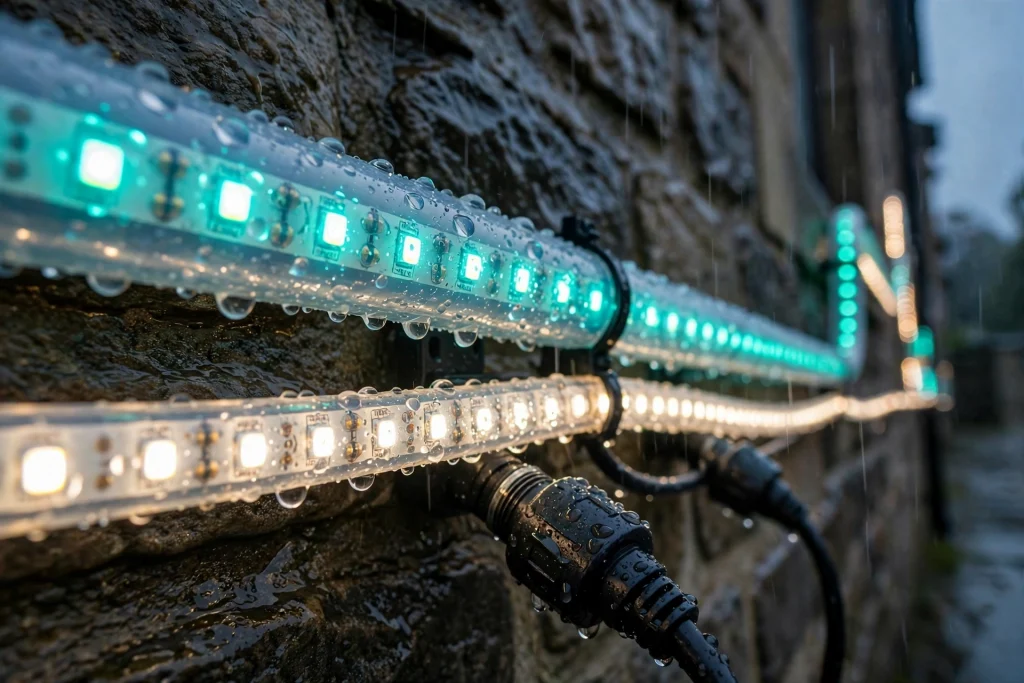
If you are buying LED pixel lights for an outdoor project, you will see the same two letters on every datasheet: IP65 vs IP66 vs IP68 LED lights — and the wrong choice is an expensive one. Pick too low and water kills the fixture in the first storm. Pick too high and you pay double for protection your installation will never need. This guide explains what each rating actually tests, when each one is the right call, and the two mistakes buyers make most often.
What an IP rating actually means
IP stands for Ingress Protection. It is an international standard defined by the International Electrotechnical Commission (IEC 60529) and used worldwide to describe how well an electrical enclosure keeps out solids and water. Every rating has two digits after the letters “IP”:
- First digit (0–6): protection against solids. For LED lighting, this is almost always 6, which means completely dust-tight.
- Second digit (0–9): protection against water. This is the digit that matters. A 5 means water jets, a 6 means powerful water jets, a 7 means temporary immersion, and an 8 means continuous immersion.
So when you read “IP65”, you are reading “dust-tight (6) and protected against low-pressure water jets (5)”. The rating describes the enclosure as tested in a lab — housing, seals and cable entries together — not just the LED chip inside.
IP code breakdown diagram
Figure: An IP rating has two digits — the first rates dust protection, the second rates water protection.
IP65 vs IP66 vs IP67 vs IP68: the comparison
| Rating | Water test (IEC 60529, summarised) | What it means in practice | Typical pixel lighting use |
|---|---|---|---|
| IP65 | Low-pressure water jets, 6.3 mm nozzle, about 12.5 L/min, from any direction | Rain and hose-down | Elevated facades, wall washers, bars and stages under cover |
| IP66 | Powerful water jets, 12.5 mm nozzle, about 100 L/min | Wind-driven rain, heavy spray, washdown | Rooftops, exposed plazas, coastal facades |
| IP67 | Temporary immersion, 1 m depth for 30 minutes | Survives standing water briefly | Ground-level runs, flood-prone areas, in-ground uplights |
| IP68 | Continuous immersion beyond 1 m, depth and duration set by the manufacturer | Built to live underwater | Fountains, pools, underwater features |
All four are dust-tight (first digit 6). The difference is entirely about water — and about what kind of water exposure.
Mistake 1: assuming a higher number is always better
This is the most expensive misunderstanding in outdoor lighting. IP67 is not a superset of IP66. The two ratings test different things: IP66 tests resistance to powerful, high-pressure water jets, while IP67 tests resistance to still-water immersion. A fixture can pass the IP67 immersion test and still fail an IP66 jet test — which is why quality products are often marked with a combined rating such as IP66/IP67.
The practical consequence: if your installation faces typhoon-driven rain or high-pressure washdowns, you need the jet resistance of IP66, not the immersion resistance of IP67. Buying IP67 for a coastal facade because “7 is bigger than 6” is buying the wrong protection. Match the rating to the exposure, not to the number.
Mistake 2: treating IP68 as “fully waterproof”
IP68 means the fixture survived continuous immersion under the conditions the manufacturer declared — a specific depth and duration stated on the datasheet. An IP68 light rated for 1.5 m for 24 hours is not automatically suitable for permanent installation at 3 m. Standard IP68 testing also does not cover chlorinated pool water, saltwater, chemically treated water or moving currents unless the manufacturer says so.
Before you specify IP68, read the datasheet for three things: the tested depth, the tested duration, and whether the rating covers the actual water chemistry of your installation. If the datasheet does not state them, treat the IP68 claim as unverified and ask the supplier.
What makes a pixel light actually achieve its rating?
An IP rating is a property of the finished product, not of the LED chip. For pixel bars, tubes and strips, the rating is earned — or lost — in three places.
The housing. Most outdoor pixel tubes use a silicone or polycarbonate extrusion that fully encloses the LED strip. Silicone-encased tubes are the workhorse here: the extrusion is a continuous seal with no seams along its length, so water has no path in. Aluminium-profile bars rely on end caps and gaskets instead, which is why the end-cap seal is the first thing to inspect on a sample.
The potting. Higher-rated products often add a second layer of protection: the electronics are potted in resin or gel so that even if water gets past the outer seal, it cannot reach the driver or the solder joints. This is standard on IP67 and IP68 products, and it is one reason they cost more — the resin adds material, weight and production time.
The connectors. This is where most real-world failures happen. A pixel tube rated IP66 is only as waterproof as its weakest connector, and many installations mix an IP66 fixture with an unrated barrel connector or a cable gland tightened by hand. When you order, ask for the connector’s own IP rating and buy the matching waterproof connectors from the same supplier, so the whole run — fixture, cable and joint — carries one consistent rating.
If a supplier cannot explain how their product achieves its rating — extrusion, potting, connector — treat the number on the datasheet with suspicion. A genuine rating always has a construction story behind it.
Which rating does your project need?
- Indoor bar, stage or nightclub: no IP rating needed. Save the money for better colour and control.
- Covered outdoor areas, elevated facades with good drainage: IP65 is enough. It handles rain and routine cleaning, and it is the most cost-effective outdoor rating.
- Exposed rooftops, plazas, coastal facades, typhoon regions: IP66. Wind-driven rain and high-pressure spray are jet problems, and IP66 is the jet rating.
- Ground-level runs, areas that flood in heavy storms: IP67. Temporary standing water is exactly what this rating is for.
- Fountains, pools, permanent underwater features: IP68 — at the manufacturer’s stated depth, and only after checking the water chemistry.
One more warning that applies to every rating: most outdoor LED failures from water start at the interfaces — gaskets, lens seals, cable glands and field-assembled connectors — not through the aluminium housing. A fixture can carry a genuine IP66 rating and still fail if its connectors are installed badly or its cable entries are left unsealed. Check the rating of the connectors too, not just the fixture, and seal every entry point on site.
The buying checklist
Before you order outdoor pixel lights, confirm these five things with your supplier:
- The exact rating and what it covers — IP65, IP66, IP67 or IP68, with the test conditions on the datasheet.
- Whether it is a combined rating — IP66/IP67 is stronger evidence than either number alone.
- The connector rating — connectors should match or exceed the fixture rating.
- The IP68 depth and duration — if applicable, in writing, for your actual installation depth.
- The warranty terms for water ingress — a supplier that stands behind its rating will say so.
Get those five answers and you will neither overpay for protection you do not need nor watch your installation die in the first storm.
Related: LED Pixel Bar · LED Digital Tube · LED Neon Flex