
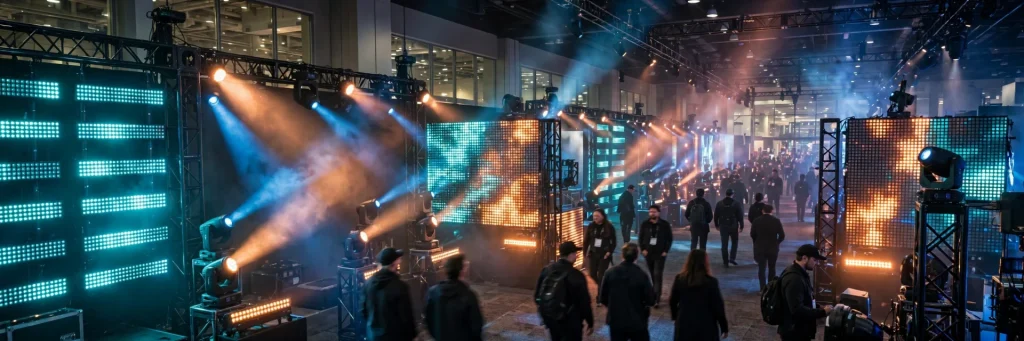
The entertainment lighting calendar has one big date left in 2026: LDI 2026 runs December 6–8 at the Las Vegas Convention Center. For anyone who buys, specifies or installs LED pixel lighting — bars, tubes, matrix panels and the controllers that drive them — the show is the fastest way to see where the market is heading before next year’s projects are specified. Here is what to watch, and what it means for your buying decisions.
LDI 2026: the show at a glance
LDI (Live Design International) is North America’s largest trade show for live entertainment technology. The 2026 edition fills the Las Vegas Convention Center’s West Hall, with exhibitors spanning stage lighting, LED video, control systems and atmospheric effects. If you are planning a 2027 venue, nightclub or touring project, the three days in December are when next year’s product lines are shown in person for the first time.
Trend 1: IP-rated fixtures move from niche to mainstream
One of the clearest LDI 2026 lighting trends is weatherproofing. Elation is using the show to unveil two new fixtures on a completely new platform, building on a decade of its IP-rated Proteus series, and several manufacturers are leading with IP65 and IP66 products this year. The message for buyers is simple: outdoor-rated is no longer a premium add-on. Venues, festivals and architectural projects increasingly expect the same fixture to work indoors and out.
The trend was already visible at Prolight + Sound Guangzhou 2026, where exhibitors ran live rain-spray demonstrations of IP66 moving heads to prove they keep working under continuous water spray. For pixel lighting buyers, the practical takeaway is to check the IP rating on every outdoor run — a pixel bar rated IP65 handles rain, but a facade or rooftop installation exposed to wind-driven spray deserves IP66. (See our guide to IP ratings for the full comparison.)
Trend 2: colour quality is now the headline spec
The second trend at LDI 2026 is “quality of light.” Elation is bringing back its hands-on Light Lab, where visitors compare fixtures side by side and evaluate colour rendering for themselves, and new full-spectrum families are debuting across several booths — fixtures designed to reproduce a wider, more accurate range of colour, including better skin tones and deeper saturated hues.
For pixel lighting, this matters because the bar for colour has risen. Buyers used to compare pixel products mainly on brightness and pixel count; now colour fidelity — smooth dimming, consistent whites and accurate saturated colours — is a deciding factor, especially for broadcast, corporate events and high-end venues where cameras are always rolling.
Trend 3: pixel control keeps getting simpler
The third thing to watch is how easily fixtures plug into pixel workflows. New product families arriving at LDI are built around network control — Art-Net and sACN as standard — and around combined fixtures that do more than one job, such as a single unit that works as both a profile spot and a Fresnel wash. The direction of travel is fewer boxes, fewer cables and one control network running the whole rig.
For installers, that means the controller is now as important as the fixture. When you evaluate a pixel bar or tube at the show, ask how it is addressed, how many universes it needs, and whether it speaks the same protocol as the rest of your rig — because a beautiful fixture that needs its own control island will cost you time on every install.
Trend 4: the show floor is becoming a networking floor
LDI 2026 is also leaning harder into the human side of the industry. ADJ, for example, is running two afternoons of “social hour” sessions at booth 3007 on December 6–7, bringing lighting designers from venues and production companies together to talk through real projects. For a buyer, these sessions are often more useful than the booth displays: they are where you hear which products actually survived a touring season.
What this means for your next purchase
You do not need to fly to Las Vegas to benefit from LDI 2026. The trends on the show floor point in the same direction for every pixel lighting buyer:
- Specify IP65 as your outdoor minimum, IP66 for exposed locations. Weatherproofing is now standard, not optional.
- Ask about colour, not just brightness. Full-spectrum output and smooth dimming are where products now compete.
- Buy into one control ecosystem. Art-Net or sACN compatibility across fixtures and controllers saves more money over a project’s life than a cheaper fixture ever will.
- Wait for the show reports before finalising 2027 specs. New platforms announced at LDI usually reach distributors in the first quarter — if your project can wait until January, you will have more choice.
LDI 2026 closes on December 8. We will follow up with a recap of the announcements that matter most for pixel lighting buyers — and which of them are worth waiting for.
Related: LED Pixel Bar · LED Controller · 3D LED Matrix